The next technique goes by several names by several different products, "NGINX Reverse Proxy", "Apache Mod_Proxy/Mod_Rewrite", "Malleable HTTP C2 Profiles", and many others. However, they are all more or less the same. All of the Proxy features more or less allow a user to control specific elements of the incoming HTTP request. Let's say an incoming connection request has an "X-C2-Server" header; we could explicitly extract this header using the specific technology that is at your disposal (Reverse Proxy, Mod_Proxy/Rewrite, Malleable C2 Profile, etc.) and ensure that your C2 server responds with C2 based responses. Whereas if a normal user queried the HTTP Server, they might see a generic webpage. This is all dependent on your configuration.
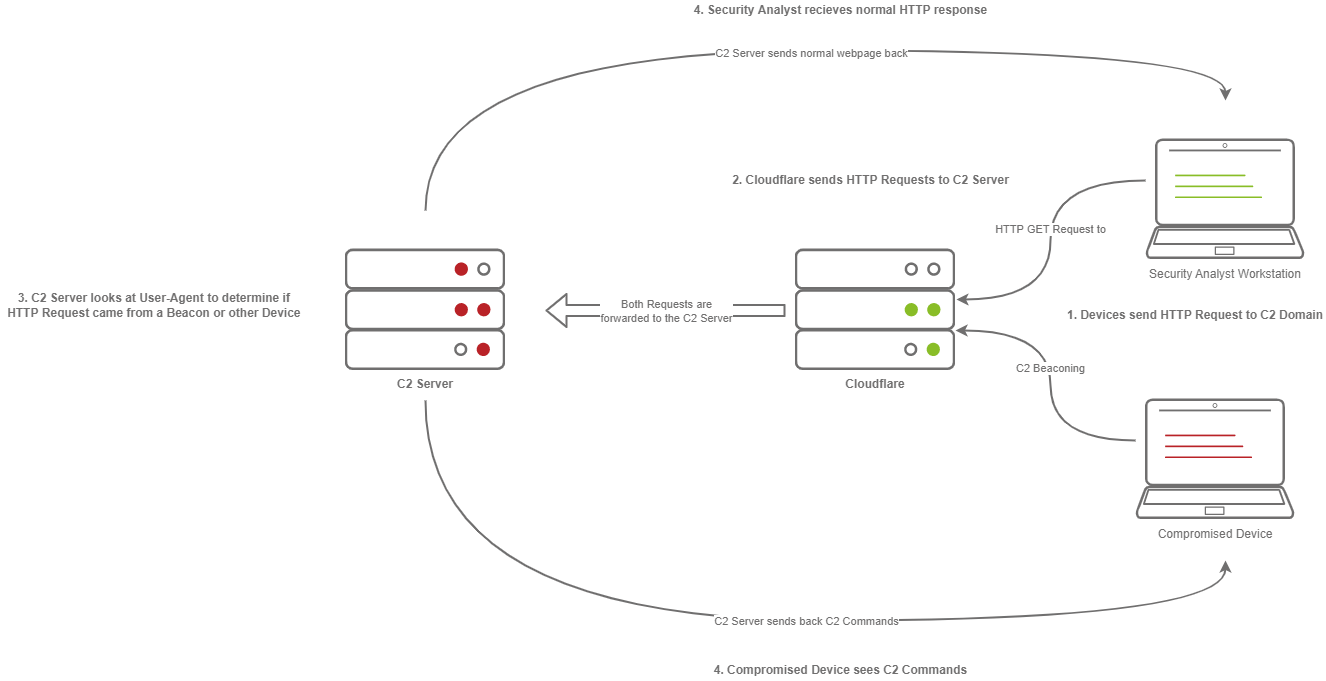
A Compromised Device and Security Analyst reach out to a C2 server, only the Compromised device gets a C2 Beacon back - the Analyst gets Cloudflare's website back.
The diagram above depicts how C2 profiles work:
1. The Victim beacons out to the C2 Server with a custom header in the HTTP request, while a SOC Analyst has a normal HTTP Request
2. The requests are proxied through Cloudflare
3. The C2 Server receives the request and looks for the custom header, and then evaluates how to respond based on the C2 Profile.
4. The C2 Server responds to the client and responds to the Analyst/Compromised device.
Because HTTPS requests are encrypted, extracting specific headers (ex: X-C2-Server, or Host) may be impossible. By using C2 Profiles, we may be able to hide our C2 server from the prying eyes of a Security Analyst.